Showing posts with label Fortuny. Show all posts

Wednesday, June 18, 2014

Style Icon: Tina Chow

Love this photograph of Tina and Michael Chow from 1979...


love, kisses and something fabulous is coming... Juliana


Sunday, December 29, 2013

Tina Chow by Antonio Lopez

Antonio Lopez, the Puerto Rican born, wonderchild of 1960s, 70s and 80s fashion illustration and joie de vivre, discovered Tina Lutz, an aspiring model, and introduced Tina to her future husband, restaurateur, Michael Chow in 1971.

I have never been a huge fan of fashion illustration, I find it frustrating not to see the actual piece but when I acquired a collection of Joe Eula drawings for Halston (seen here) for RARE vintage, those images: a swish of color, a smudge of red for lip, changed my opinion on fashion illustration.  I still prefer a photograph to a drawing but I realize now that a drawing can capture its own mood and moment in fashion.

I love Antonio Lopez's fashion drawings - particularly the 1960s and 1970s - but I actually prefer his Polaroids.  They are sexy, intimate, playful and spontaneous.

Here is Tina Chow as captured by Antonio Lopez in Polaroid...

Tina in her gauzy Fortuny Delphos Dress:

Tina Chow by Antonio Lopez

Tina with Michael Chow.  I LOVE her dress!  Does anyone recognize the designer of the dress?  Chanel?  Maybe Chloe?


All images from Antonio Lopez: Fashion, Art, Sex & Disco by Roger and Mauricio Padilha

Thursday, August 8, 2013

An Unconventional Beauty: Natacha Rambova in Fortuny

On June 7th 1916 there was notice in the New York Times about a missing girl, a Miss Winifred de Wolfe:   Miss de Wolfe was last seen in the costume shop E.S. Freisinger on West forty-first street trying on costume gowns.  Miss Wolfe, a niece of the interior decorator, Elsie de Wolfe, had recently informed her mother that she would be dancing on stage with the Russian Imperial Ballet and the dancer Kosloff.  Mrs. de Wolfe was not happy with this arrangement and tried to dissuade her daughter.    Miss de Wolfe is rumored to have met Kosloff at the costume shop to which he had brought a new traveling case.  That is the last trace those who have been searching for her have been able to unearth. 


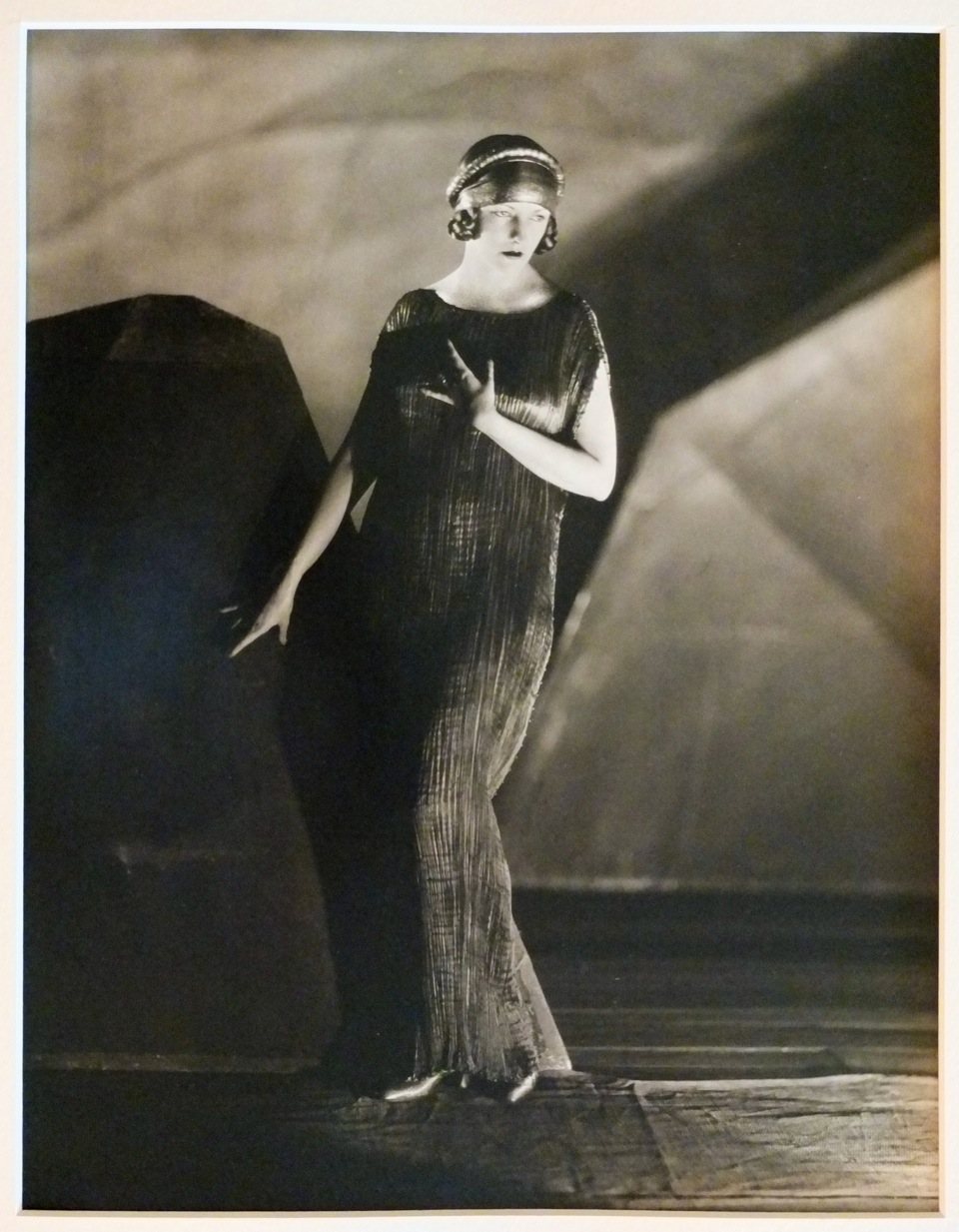
The above is an extremely iconic image of a Fortuny Delphos gown worn by Natacha Rambova and photographed by James Abbé.  

I am thrilled to be able to offer a rare and iconic vintage print of this photograph at RARE vintage.  The photograph was acquired by the present owner from the gallery Hastings in New York.

"I loathe fashion.  I want to dress in a way that is becoming to me, whether it is the style of the hour or not.  So it should be with all women in my opinion." Natacha Rambova

Who was Natacha Rambova?  She was most famously the wife of Rudolph Valentino but Natacha Rambova was actually born Winifred Shaughnessy in Salt Lake City, Utah.  When her mother married Edgar de Wolfe, the brother of Elsie de Wolfe, she became the above mentioned missing Winifred de Wolfe.  She had a rebellious  nature, much to the dismay of her social climbing mother, and was thrown out of her boarding school for "conduct unbecoming to a lady".

When she was 17 she went to New York, where she changed her name to Natacha Rambova and began a love affair with the much older dancer Kosloff of the Imperial Russian Ballet Company.  Her mother was scandalized and brought statutory rape charges against Kosloff but later dropped the charges and even underwrote the costumes for the ballet company.

Kosloff was hired by Cecil B DeMille to act and to contribute costume designs to his films.  But the real talent was Natacha - although Kosloff did not give her any credit for her designs - eventually she was discovered as being the brains and the beauty behind the costume and set designs.

See how beautiful - and exotic - she was!


She married Rudolph Valentino in 1922 and they collaborated on many his films together amidst a lot of celebrity scandal: accusations of bigamy and gossip that she was controlling Valentino's career and over-bearing...

Valentino described her style: "At last we were ready to visit M. Poiret.  He is the one costumier in Paris best suited to Natacha's temperament.  She looks best in vivid colors, no one color over another, but all colors that are violent and definite.  Scarlets.  Vermillions. Strong blues.  Emphatic greens.  Loud voiced yellows.  Blazoning purples".  Fortuny was of course sold at Paul Poiret's shop in Paris.  I wonder what color her Fortuny was in the Abbé photo?


After she and Valentino divorced in 1925, Rambova moved to New York and in 1928 opened her own dress boutique on West 55th Street.  The New Yorker described her clothes as "intensely individualistic" and for women who were "very sure of their personalities".

"Rambova disclaims allegiance to the Paris designers and goes for inspiration to the arts of China, Persia, India, Egypt and to the costumes of the medieval and Renaissance ages."
The New Yorker 1928


Natacha Rambova dresses in the collection of Phoenix Art Museum

Natacha closed her studio in 1931 and went on to have a career as an expert in Egyptian, Tibetan and Nepalese artifacts.  She died in 1966.


The James Abbé photograph of Natacha Rambova in a Fortuny Dephos is available at RARE vintage.  The photograph is often used in books and exhixbitions on the work and designs Mariano Fortuny.  It measures 11 X 14" and was purchased at Hastings gallery in New York.


Monday, May 20, 2013

Monday's RARE vintage Photo of the Week #3: Tina Chow

Is there any better way to start a stylish week off then with the super stylish Tina Chow?  As I am certain you know, we have had an unsurpassed collection of Tina Chow's jewelry at RARE vintage which has been an enormous privilege as well as an enormous source of excitement for me personally and, of course, also for our clients.

Tina Chow could wear a grey cashmere sweater and black Kenzo pants, brand spanking new haute couture from the newly appointed designer for Chanel Karl Lagerfeld in 1983, vintage haute couture from Balenciaga, Vionnet, Poiret and Fortuny with such ease and casual chic that her unerring sense of style has made her one of the best dressed women of all time.

But she was not just a woman of style - she was a woman of substance - which I really think most super stylish women are.  A true sense of style is found in women who love not just fashion but history and design.  

This is one of my favorite photos of Tina Chow.  She is wearing a Fortuny silk pleated gown with her own jewelry.  

Tina Chow in Fortuny and Tina Chow jewelry

It has been erroneously published that she was wearing lucite (!) jewelry with her Fortuny gown but she is in fact wearing her own amazing crystal quartz cuff and bracelet and one of her spectacular bamboo wrapped Kyoto bracelets.

Tina Chow's sense of style is unique to her and it continues to inspire us...  as Yves Saint Laurent said, "Fashion fades, style is eternal".  Tina Chow is eternal...

I am always looking for rare and pristine examples of Tina Chow's incredible jewelry.  Please feel free to contact me at info@rarevintage.com or phone 212.581.7273 if you have a piece or collection you would like to part with.


Friday, January 18, 2013

SEE: Fortuny y Madarazo: An Artistic Legacy

One evening in late November, I went to the opening of the Fortuny y Madrazo: An Artistic Legacy opening at the Queen Sofia Institute.

Photos are by Andrea Cairone for RARE vintage

The QSSI has in partnership with its chairman, Oscar de le Renta, begun an annual costume exhibit which in just three years has become a must see on the fall schedule of shows in New York.  The first exhibit I saw at the QSSI was the beautiful and dramatic Balenciaga: Spanish Master curated by Hamish Bowles which explored the enduring influence of Balenciaga's homeland in the haute couture he designed while living in Paris.

It was not so long ago I saw a Fortuny exhibit in Venice at the palazzo where Fortuny lived and worked, which is now the Fortuny Museum, near San Marco.  It is a very transformative experience to visit the Museo Fortuny.  You step out of the sunlight, the mad crush of tourists and onto the creaking wood floorboards into the dark and enveloping interior of the palazzo.  You are surrounded by Fortuny's textiles, reflector lamps, silk lanterns and paintings.  The paintings are hung lavishly dense, floor to ceiling.

You easily forget yourself admist the collection.  It is almost a shock to look down and find yourself not dressed in a silk pleated Delphos gown.  But Venice has that effect on you: at some point you feel like a character in the Merchant Ivory film Wings of the Dove.  Or that must be on your way to a ball at the Palazzo Labia given by Charles Bestequi.  Or if you arrive in February during Carnevale and take a water taxi when the sky is dark and the palazzos are lit by glass chandeliers blown on the island of Murano, you may see a man on the piano nobile of a palazzo on the Grand Canal in an embroidered frock coat and a powdered wig and you will surely think its the 18th century.

That is Venice, timeless, slipping from one century to another.  But back to Fortuny, not in Venice but in New York.

The exhibit, Fortuny y Madrazo: An Artistic Legacy, at the Queen Sofia Institute is as much about the Fortuny family of artists as it is about Fortuny's fashion.

Fortuny was an artist born into a family of artists in Granada in 1871.

Tempura paints, Delphos fabric swatches, roller used for printing textiles and Fortuny brochure

Fortuny's grandfather and father were famous and exceptional artists but he followed a more independent path become an inventor, a photographer, a fashion designer.  But he always thought of himself as an artist.

His choice of medium was silk, cotton gauze, velvet, glass beads.

The palette for his silk pleated dresses was found in the colors of the sky, the watery canals of Venice and the colors of the sun setting on the Giudecca.

Like many artists in the age of Impressionism, he was inspired by Orientalism, exotic motifs, the artifacts and costumes of the Far East.  He studied the the sculptures of ancient Greece and crafted the classical drapery which adorned those statues not in marble but in silk.

And like a painter painting a nude, Fortuny thought a woman's body should be liberated from corsetry. The dresses, worn without a corset, were initially quite shocking and were worn by women who were not concerned with convention like the Marchesa Casati, Isadora Duncan and Peggy Guggenheim.

Jacket 1930-1940s.  Acqua silk velvet, champagne silk satin.  Delphos 1930s-1940s.  Peach silk satin, silk cord, glass beads.  Both Sandy Schreier collection.

Coat 1920s.  Brown silk velvet, green silk velvet.  Sandy Schreier collection.  Delphos dress.  Gold silk, silk cord, glass beads.  Mark Walsh leslie Chin collection.

Djellaba 1915-1930s.  Ivory silk, aqua silk, glass beads.  Mark Walsh Leslie Chin collection.

This was one of my favorite ensembles in the exhibit:

Jacket 1915-1930s.  Robin's egg blue cotton crepe, silk cord, glass beads.  Sandy Schreier collection.  Delphos dress 1930-1940s.  Cornflower blue silk, silk cord, glass beads.  Worn by Cynthia Gregory.  Regina Drucker collection.

Cynthia Gregory was a ballerina with the Amercian Ballet Theatre in New York.  She was described by Rudolph Nureyev as "America's prima ballerina assoluta".

Coat 1920-1940s.  Apricot silk velvet, metallic print.  Keith H. McCoy collection.   Delphos dress 1920-1940s.  White silk, silk cord, glass beads.  Keith H. McCoy collection.

The very first piece inside the exhibit that you see belongs to one of my dearest friends, the collector extraordinaire, Regina Drucker.  I asked Regina about her collection and this is what she told me:

"Years have passed with many additions but one of my favorite pieces came via Madame Trois, who was once the only dealer in Venice of Fortuny's fabrics and a close friend of the Countess Gozzi.  She lives in a palazzo on the grand Canal that has been in her family for over 200 years.  Every trip my husband and I take to Europe includes a pilgrimage to Venice.  One day she pulled a small box out and within was the most beautiful velvet and gold stenciled drawstring bag.  she offered it to me, as she had no daughters.  I was so taken with the beauty of this gesture.

Regina's bag from Madame Trois.

"A few years ago, with my sister Genevieve, I visited a shop around the corner from Madame Trois.  It had never been open in all of my past visits.  I walked in and there in the back of this dim little shop on a padded hanger over a door, was the most beautiful velvet full length coat.  It shimmered in its pale beauty in the darkness.  I was told that it was made by Fortuny as a wedding gift.  the owner complained that he was closing his shop after 35 years in business as tourists had changed to day-trippers off the gargantuan ships bringing the hoards who stare, eat and buy trinket souvenirs... no one wants antiques anymore and the cost of living in Venice was too prohibitive even for a Venetian.  He closed the following day and the coat is with me now."

Regina's coat (on far left) 1930-1940s.  Aqua silk velvet, peach silk, silk cord, glass beads.  Regina Drucker collection.

Abaya 1920-1940s.  Gold silk velvet.  Keith H. McCoy collection.

(Left)  Kimono 1930-1940s.  Cerulean blue silk velvet, peach silk satin, silk and metallic cord, glass beads.  Worn by the Countess Gozzi.  Fortuny Inc. and the Riad family collection.

The Countess Gozzi was an Amercian interior designer who founded Fortuny Inc. in New York in 1927 and imported the fabrics and dresses of Fortuny.  When Fortuny died, she sold her Italian villa to buy the company.  She remarried and became the Countess Gozzi and went onto work at the Fortuny factory on the island of the Giudecca until she was over 100 years old.


Jacket 1930s.  Pale blue silk gauze.  Mark Walsh Leslie Chin collection.  Delphos dress.  Cornflower blue silk, metallic print, silk cord, glass beads.  Fortuny Inc and Riad family collection.

This was a particularly striking  grouping in the exhibit:

(Left to right) Scarf 1920-1940s.  Sky blue silk gauze.  Mark Walsh Leslie Chin collection.  Delphos dress 1920-1930s.  Aquamarine silk satin, silk cord, glass beads.  Regina Drucker collection.  (Middle) Delphos dress 1930s.  Ice blue silk, silk cord, glass beads.  Keith H.McCoy collection.  (Right)  Scarf 1920-1940s.  Rose print silk gauze.  Mark Walsh Leslie Chin collection. Delphos dress 1930.  Chanpagne silk.  Mark Walsh Leslie Chin collection.

(Left) Chlamys 1920-1940s.  Brown silk velvet, green silk velvet, beige silk satin.  Mark Walsh Leslie Chin collection.  Peplos dress 1930-1940s.  Sage green silk satin, silk cord, glass beads.  Regina Drucker collection.

And what of Fortuny's Delphos and Peplos dresses?  Why are the fabrics still manufactured but not the dresses?  Because Fortuny, who was highly secretive about the process of pleating the dresses, did not want them to be made after his wife Henriette's death.

Lucky for us we can still see the fine Japanese silk that Fortuny set by hand with heated ceramic cylinders into hundreds of fine pleats at the Queen Sofia Institute in New York.

Fortuny Y Madrazo: An Artistic Legacy
at the Queen Sofia Institute
684 Park Avenue
November 30, 2012- March 30, 2012

I would like to thank the Queen Sofia Institute which generously allowed us to photograph in the galleries for the RARE vintage blog.

Wednesday, June 22, 2011

A Fine and Beautiful Fortuny-Style Patricia Lester

"I should love to see Venice." "You may before long be able to gaze at the marvelous stuffs which they used to wear. One use to be able to see them only in the works of the Venetian painters. But I hear that a Venetian artist, called Fortuny, has rediscovered the secret of the craft, and in a few years time women will be able to wear brocades as sumptuous as those that Venice adorned her patrician daughter with."
Marcel Proust In Search of Time Lost, 1919

What immediately struck me about this Patricia Lester gown when I was shown it, is the amazing color and how the color is used. It is timeless and very modern at the same time. The hand pleated silk ranges in color from a mocha to a deep brown. A row of tiny beads adorns the neckline. The dress buttons on the side by beautiful thin loops of silk.


1980s Patricia Lester hand pleated silk gown.  Size 4/6.
PURCHASE

LinkWithin

Related Posts with Thumbnails